Techcrunch had this very poignant post yesterday and I had to steal the title. The jest of it is that sometimes too much money is no good. Or that even with all the resources in the world nine women cannot produce a baby in one month – but sometimes it sure feels like we try.
So, even if you DO have your entire budget in the piggy bank, put it into a interest bearing CD and allow yourself to sit on your idea. Of course nobody in the independent film world has their piggy bank stocked. As you scramble for your budget for the next film remember that the universe is giving you ample time to gestate your next, perfect project. Voila.

Thursday, March 31, 2011


Monday, March 14, 2011
Truth - Part 2
“Identity lives in the space between invention and reality.”
What is truth? Truth is the sum of a society’s conventions. There are rules and meta-rules, which are unknown knowns, call them habits or unspoken conventions that set the parameters for moving flawlessly through a society. It is a social network of implicit rules that tell you how to deal with the explicit rules.
Immigrants come into a new set of rules that are the makeup of their host society. Some rules are obvious, some are not. Assimilation and integration starts with learning of the explicit rules. But the meta-rules or implicit rules we only learn over time by trial and error, by using our intuition and assessing situations and reactions to us.
When too many people do not know the implicit rules of a society, the context for these rules weakens. Once the rules lose their context, they collapse. That is what ‘fear of the Other’ really is – a fear of losing one’s own truth.
[Watch 90 absolutely fascinating minutes of Slavoy Zizek’s discourse in Prague (2007) on “How are we Embedded in Ideology”.]
What is truth? Truth is the sum of a society’s conventions. There are rules and meta-rules, which are unknown knowns, call them habits or unspoken conventions that set the parameters for moving flawlessly through a society. It is a social network of implicit rules that tell you how to deal with the explicit rules.
Immigrants come into a new set of rules that are the makeup of their host society. Some rules are obvious, some are not. Assimilation and integration starts with learning of the explicit rules. But the meta-rules or implicit rules we only learn over time by trial and error, by using our intuition and assessing situations and reactions to us.
When too many people do not know the implicit rules of a society, the context for these rules weakens. Once the rules lose their context, they collapse. That is what ‘fear of the Other’ really is – a fear of losing one’s own truth.
[Watch 90 absolutely fascinating minutes of Slavoy Zizek’s discourse in Prague (2007) on “How are we Embedded in Ideology”.]
Thursday, March 10, 2011
The Future of Storytelling
Chris Brogan’s series of posts on the future of media, work, marketplaces and community got me thinking about the future of storytelling. Something we are thinking about a lot in the Quo Vadis Think Tank (more on that later).
The future of storytelling is non-linear (sadly, as far as I’m concerned), media centric and for that reason flexible, I would venture to guess also more fragmented and modular. Storytelling will be increasingly interactive, in cases even crowd-sourced, free and digital. Copyright will get a run for its money and need to reinvent itself… I also think the message of the story will become more important.
The message has always been the core for documentaries; and maybe I’m co-mingling message with truth. As documentaries will have to adapt to non-linear, media centric, flexible, interactive and free – how does that change the story? Is the story the message and the medium?
Which brings us to Marshall McLuhan: “The Medium is the Message”. McLuhan says that societies have always been shaped more by the nature of the medium by which people communicate than by the content of the communication. To which I would add: there are about three (maybe five, ok, no more than ten) original plot lines in the world, any other narrative is a derivative or embellishment thereof.
Where IS the message today? Where IS the story? What story does the medium itself give us and how will it shape us into the future? How will Romeo and Juliet, Pygmalion and the Iliad come to us? IS the internet the medium or the meta-medium ultimately?
The future of storytelling is non-linear (sadly, as far as I’m concerned), media centric and for that reason flexible, I would venture to guess also more fragmented and modular. Storytelling will be increasingly interactive, in cases even crowd-sourced, free and digital. Copyright will get a run for its money and need to reinvent itself… I also think the message of the story will become more important.
The message has always been the core for documentaries; and maybe I’m co-mingling message with truth. As documentaries will have to adapt to non-linear, media centric, flexible, interactive and free – how does that change the story? Is the story the message and the medium?
Which brings us to Marshall McLuhan: “The Medium is the Message”. McLuhan says that societies have always been shaped more by the nature of the medium by which people communicate than by the content of the communication. To which I would add: there are about three (maybe five, ok, no more than ten) original plot lines in the world, any other narrative is a derivative or embellishment thereof.
Where IS the message today? Where IS the story? What story does the medium itself give us and how will it shape us into the future? How will Romeo and Juliet, Pygmalion and the Iliad come to us? IS the internet the medium or the meta-medium ultimately?
Tuesday, February 22, 2011

Monday, February 21, 2011
The Future of Media
Chris Brogan posted a thoughtful and thought provoking post today: Make sure to read the comments too.
A few thoughts in random order:
I agree with Chris a 100% on "first" and "full" news, there will be no doubt a lot more immediate news that will hit us as soon as it happens. As I don't think that most consumers will have the time, ability or inclination to verify validity of news, curation will be paramount. There is more raw data (see Wikileaks), but there is also much more possibility for misinformation.
And yes, content will be serial, shorter, interactive, on more touch points (venues), linked (data rich), mobile, and subscriber based.
Two things Chris does not address here are, first the unwillingness of the general heavy-internet users (younger generation) to pay for any content. So with the entire talk about monetization on the internet is a big question mark and a huge one not to be dismissed. I'd love to hear any thoughts about that.
And secondly, we assume that we all have access to the internet 24/7 and at broadband speed. There are entire sections of this country that have NO internet access and rely on dial-up phone lines. This creates a very dangerous vacuum. As we move more and more into a virtual world - the knowledge gap (i.e. socio-economic gab) will widen exponentially.
What is your take on this?
A few thoughts in random order:
I agree with Chris a 100% on "first" and "full" news, there will be no doubt a lot more immediate news that will hit us as soon as it happens. As I don't think that most consumers will have the time, ability or inclination to verify validity of news, curation will be paramount. There is more raw data (see Wikileaks), but there is also much more possibility for misinformation.
And yes, content will be serial, shorter, interactive, on more touch points (venues), linked (data rich), mobile, and subscriber based.
Two things Chris does not address here are, first the unwillingness of the general heavy-internet users (younger generation) to pay for any content. So with the entire talk about monetization on the internet is a big question mark and a huge one not to be dismissed. I'd love to hear any thoughts about that.
And secondly, we assume that we all have access to the internet 24/7 and at broadband speed. There are entire sections of this country that have NO internet access and rely on dial-up phone lines. This creates a very dangerous vacuum. As we move more and more into a virtual world - the knowledge gap (i.e. socio-economic gab) will widen exponentially.
What is your take on this?
Thursday, February 10, 2011

Wednesday, February 2, 2011
A wedding to be held!
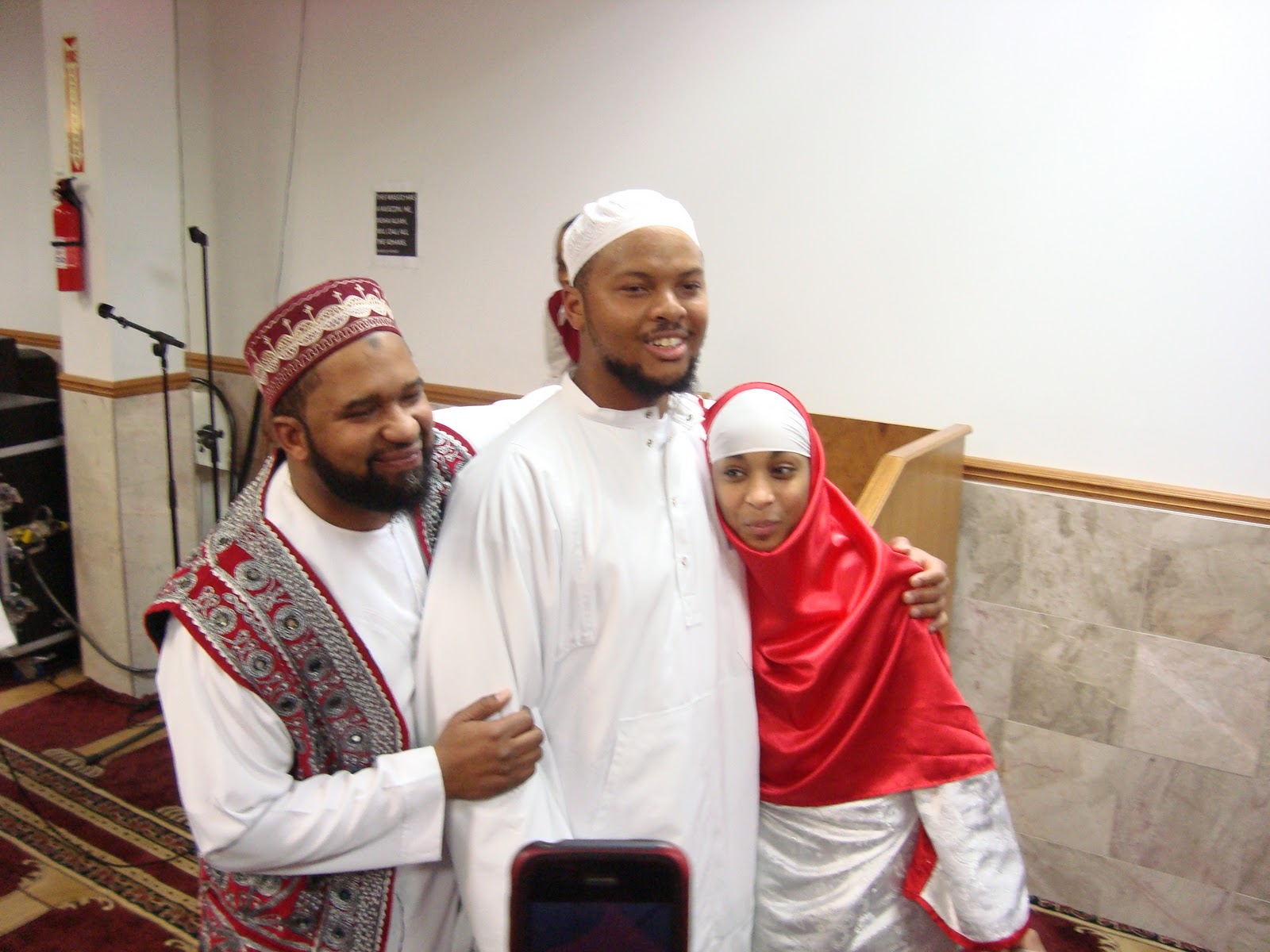
In Abraham's Children, Naeemah Rashid talks about being nervous and excited about getting married to Mohammed - the man she's been engaged to since she's been 14. It's two years later and last Friday evening Naeemah, now 19 and Mohammed 25, tied the knot (so to speak). I was fortunate to be witness the ceremony at Masjid at Taqwa in Brooklyn. I loved hanging out with the maid of honor, Saeedah, while we waited three hours for the ceremony to start (not a Swiss affair) and chatting without a camera or an agenda. Naeemah, was nervous and excited, but positively glowing and I wish her and Mohammed a life of love, partnership and happiness, inshallah.
 |
| Saeedah & Naeemah Rashid |
 |
| Tariq Rashid, Mohammed & Naeemah |
 |
| Naeemah, Nina, Saeedah, brother, Malika |
 |
| Naeemah - how do I look? |
Subscribe to:
Posts (Atom)